Biodiversity Heritage Library |
|
|
Replace Gatekeepers with Guardrails |
By Jana Werner and Phil Le-Brun |
Most leaders are exhausted. But they aren’t exhausted by the work itself; they are exhausted by the friction. The missed connections. The circular meetings. The feeling that every good idea must navigate a minefield of permissions before it can see the light of day.
If you feel this way, you are likely operating inside a Tin Man organization. You know the character from The Wizard of Oz—rigid and clumsy with rusted joints. The Tin Man organization was built for assembly lines, predictable outputs, and people acting like reliable cogs that do great when well-oiled. But in a world that moves like a turbulent ocean, that metal suit isn’t just heavy—it’s rusting and irreparable. And the Tin Man needs a heart, remember. There is a more fluid, alive way to work and lead. Meet the octopus.
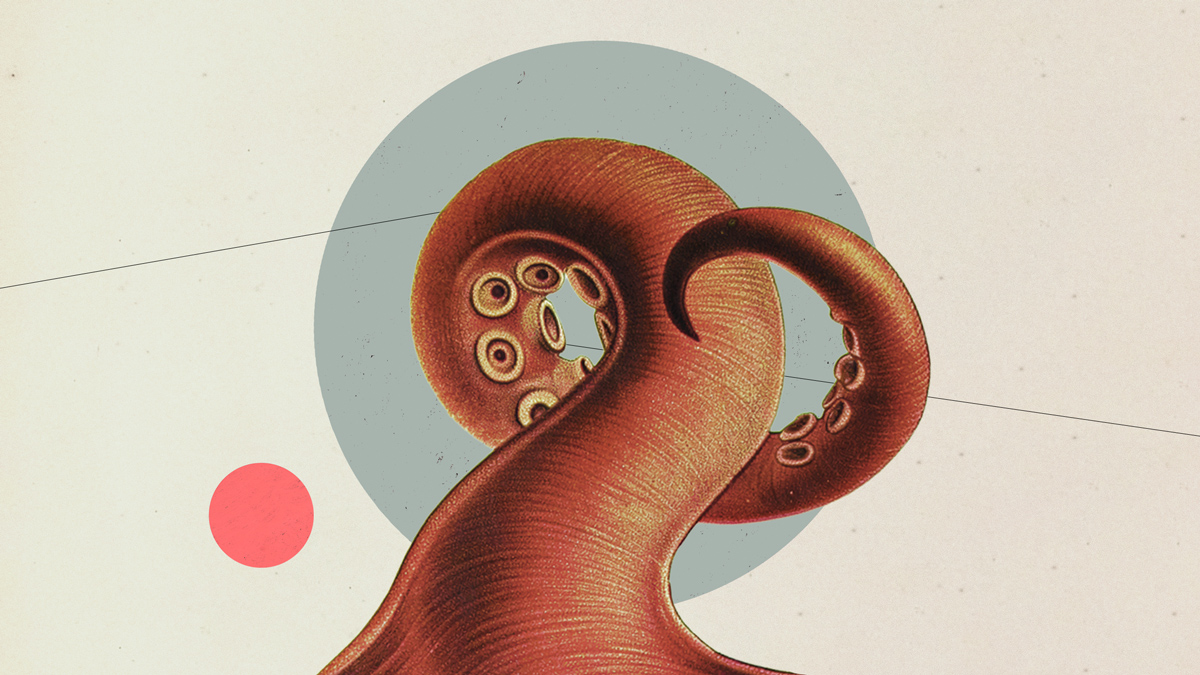
An octopus is one of the most sophisticated creatures on earth, nature’s master of distributed intelligence. We know they’re smart—a YouTuber taught an octopus how to play the piano—but intelligence is only the beginning. It is so adaptive it can change its color, texture, and shape in seconds to adapt. It can even change its RNA to adjust to new conditions at speed. Two-thirds of its neurons are in its arms. Each arm can think, sense, and act independently while remaining perfectly aligned with the whole. It senses subtle signals in the turbulent flow of the ocean and learns instantly. It doesn’t follow a three-year “strategic map” to find a crab; it detects a signal and adapts instantly. It also has a great sense of humor.
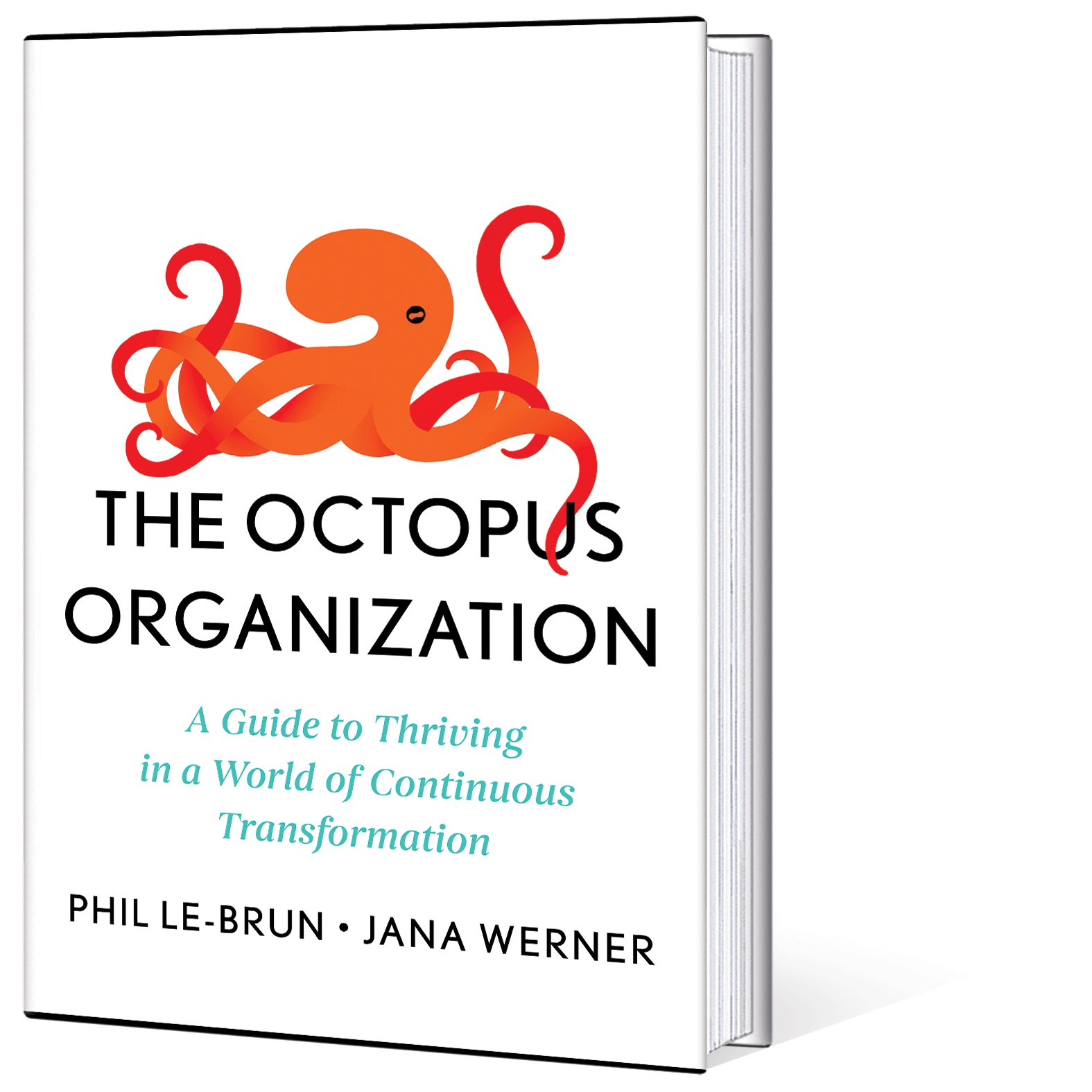
We wrote our book, The Octopus Organization, because we believe that the only way to thrive in a world of continuous transformation and technology disruption is to stop being a machine and to start becoming a living organism.
We are Jana and Phil. We’ve spent our careers helping some of the world’s largest organizations—from the kitchen floors of McDonald’s to the data centers of Fortune 500 digital powerhouses—trade their metal suits for something more fluid. We’ve seen that the most adaptive organizations don’t “transform” through grand plans; they advance by shedding antipatterns—those rusted, Tin Man habits that feel like best practices, but actually hold organizations back.
Over the next eight weeks, we’ll share some of these antipatterns, help you understand why they happen, and give you one practical thing you can do to begin to escape the antipattern, right then and there. One habit at a time. We’re going to help you rediscover clarity, ownership, and curiosity—the things that a modern organization needs to survive. We’re going to help you build an organization that can learn as quickly and gracefully as our eight-legged friend. Think of this as a guide to becoming a more “alive” leader.
First up: The one habit that turns your best innovators into bored “clock-punchers.” Let’s talk about gatekeepers. |
Raise your hand if you’ve ever had a good idea—a really good idea that energized you just thinking about it—you just knew it would fix a chronic customer pain point or solve a bottleneck. But then that beautiful little moment of innovative thinking experienced a slow, agonizing descent into the bureaucratic maze.
You wait for your boss to check with their boss, who suggests a “sync” with Marketing, who asks you to submit a formal business case that they’ll review and share with Legal, who will review it in legal time. Everyone loves it, but wait, what about resources? How much money do you want? How long will it take? Why wasn’t IT looped in? Can we call a meeting to discuss this first after that key person is back from vacation?
All you wanted to do was add a little value, but you found yourself, as former Coca-Cola Corporate CIO Miriam McLemore calls it, “running the gauntlet of everyone who can say no.” When your innovative proposal gets dunked, spun, and transformed through layers of bureaucratic obstacles, it’s not so funny when it emerges, unrecognizable from its original form, if it emerges at all. Your initial surge of excitement and energy are replaced by a shrinking sadness and growing cynicism about how much your ideas are actually valued.
What’s happening here emerges from the Tin Man’s assembly line mindset where top-down command required certain chains of approval to control production and productivity. Checking work improved efficiency and reduced errors. It added value. In a modern, complex organization that needs to find new ways to grow and thrive, it does the opposite. It stifles value.
If you’ve been a gatekeeper—who hasn’t?—you know you weren’t deliberately trying to hold people back. You care deeply about the outcome and don’t want to see the organization stumble. But in today’s complex world, that protective instinct to sign off on every decision across multiple silos inadvertently turns us into the very bottleneck we’re trying to prevent.
When we insist on being the final checkpoint, we unintentionally signal to our teams that their judgment is secondary to ours. Today, gatekeeping is a silent killer. As Netflix’s co-CEO Reed Hastings warns, when you try to “dummy-proof” a system, eventually only dummies want to work in that system. |
Replace Gatekeepers with Guardrails |
Octopus Organizations realize that breakthrough performance requires agency over permission. Instead of checkpoints, they build guardrails—pre-established boundaries that define a safe-to-operate zone. Leaders encourage teams to make decisions and move forward on ideas, within the safe zone.
There are many ways to decide on appropriate guardrails. W.L. Gore uses the waterline principle. Ask: “If this decision goes wrong, does it sink the ship (below the waterline) or just get us wet (above the waterline)?” If it’s above the waterline, stop reviewing it. Tell your team: “You have full authority to make this decision if it meets criteria X and doesn’t risk Y. I trust your judgment.”
It’s our experience that this is massively uncomfortable for leaders at first because it feels like a loss of control, even a loss of relevance. If our job isn’t to tell people what they can and can’t do, after all, then what is it?
The job is to shift from control to creating and improving systems of work, to grant freedom and trust, with safe guardrails. Guardrails dismantle bureaucracy, and energize teams and individual contributors. More, and better, ideas for creating value will begin to emerge |
|
|
Introduce “If/Then” guardrails for one common scenario. Identify one routine decision that currently requires your signature but is rarely, if ever, rejected. Instead of making case-by-case decisions, define a simple guardrail: |
“If X condition is met (e.g., budget is under $5k and aligns with Strategy Y), then you may proceed. If Z condition is present, only then consult with me.” |
By replacing gatekeepers with guardrails, teams move faster, take greater ownership, and deliver better results—all while maintaining the necessary checks and balances that protect the organization. |
|
|
Next week, we’ll be covering jargon—and why it’s a more insidious problem than you might expect. In fact, it may be derailing your entire organization. We’ll share how to curb the language of “corporatese” in your company, and how to communicate in a way that invites ownership and curiosity.
See you next week. |
|
|
You are receiving this because you registered at hbr.org to receive Becoming an Octopus Organization emails, or you provided us with your email address.
If you prefer not to receive Becoming an Octopus Organization emails, please unsubscribe.
You may also Manage Email Preferences, view our Privacy Policy, or Contact Us.
To ensure email delivery, add emailteam@emails.hbr.org to your address book, contacts, or safe sender list.
Harvard Business Publishing, 20 Guest St, Suite 400, Brighton, MA 02135
Copyright © 2026 Harvard Business School Publishing. All rights reserved. |
|
|
|